How to run a post-mortem and celebrate, on one hand.
When a project ends, most of us move straight on to the next thing. Stop for half an hour first. Look back, write down what you learned, and celebrate the people who got you there.
The 1-minute version
- Picture it: what did we set out to do, and what happened?
- Map it: walk through it in order. What worked, and what didn’t?
- Try it: pick one or two changes to test next time.
- Launch it: give each change an owner and a date. Say it back.
- Close it: high five by name, celebrate, keep your notes.
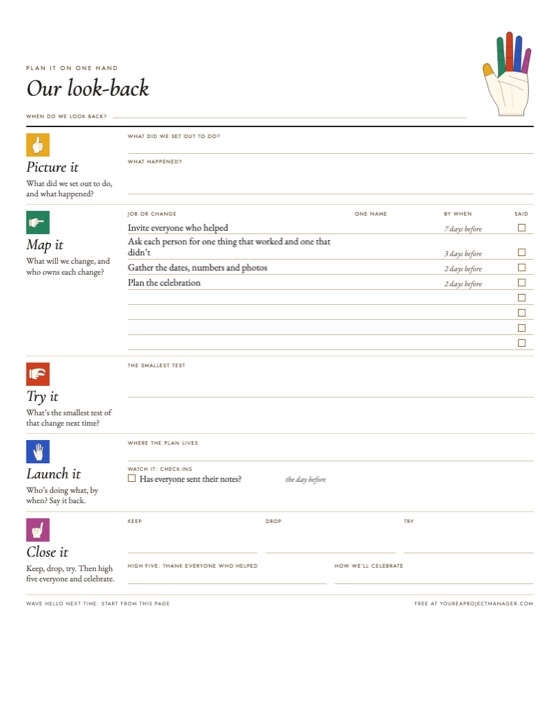
Plan yours on one page
The usual jobs are already listed. Fill it in here and send each person their part, or print it and use a pen. No sign-up.
- Thumbs up
Picture it. Say what you set out to do, and what happened.
- Put the plan and the real result side by side. Dates, numbers and photos help.
- Start with what went well, so people relax before the hard parts.
- Point the way
Map it. Walk through it in order, without blame.
- Go from the first day to the last, and ask “what happened?” rather than “who did it?”
- Ask everyone to write their thoughts down before anyone talks. Quiet people often saw the real problem.
- When something went wrong, keep asking why until you reach something you can change.
- Just a pinch
Try it. Pick one or two changes to test next time.
- You can’t fix everything at once, so choose the changes that would help most.
- Keep each one small enough to try: a checklist, an earlier start or a second pair of eyes.
- Put a ring on it
Launch it. Give each change an owner and a date.
- One name per change. Ask that person to say it back.
- End with clear next steps, so the talk turns into something that happens.
- Pinky promise
Close it. High five everyone, celebrate and keep your notes.
- Thank each person by name, and say what they did. Specific thanks mean more.
- Celebrate even if it didn’t all go well. People still gave their time, and you learned something.
- It can be small: a toast, a cake, a note to the group or an early finish on Friday.
- Write down keep, drop and try, and save them where you’ll find them. Next time, wave hello and start from there.
Which one when?
- After a big launch: book an hour within a week or two, while people still remember.
- After a family event: ten minutes over the washing up is plenty.
- After something went badly: wait a day or two so people can talk calmly, and spend longer on what you’ll change.
Quick questions
What’s the difference between a post-mortem and a retrospective?
They’re close cousins. A post-mortem usually looks back once, after a project ends or something goes wrong. A retrospective is usually a regular check-in on how a team works together. The five steps here suit both.
What questions should you ask in a post-mortem?
What did we set out to do? What happened? What worked, and what didn’t? Why did it happen? What will we keep, drop and try next time, and who owns each change?
How do you keep a post-mortem from turning into blame?
Talk about what happened, rather than who did it, and ask people to write before they speak. If the person leading it admits their own misses first, others usually feel safer to do the same.
Picture it · Map it · Try it · Launch it · Close it